75% of new enterprise apps will be developed on low-code or no-code platforms by 2026, according to Gartner. For mid-size to large organizations in the retail, healthcare, fintech, logistics, and tech services sectors, this change entails more than just creating less code.
Businesses are using low-code platforms as a competitive advantage due to a lack of IT talent, rocketing development costs, and the need to speed up customer-facing innovation. The advantages are quantifiable. As citizen developers, or non-technical employees trained on business-approved tools, become involved in the innovation process, application development speeds up by 90%, costs are lowered by 70%, and IT backlogs are decreased.
For businesses looking to scale Salesforce Marketing Cloud (SFMC), modernize their CRM systems, or enter new markets, the year 2025 will be the tipping point for low-code dominance.
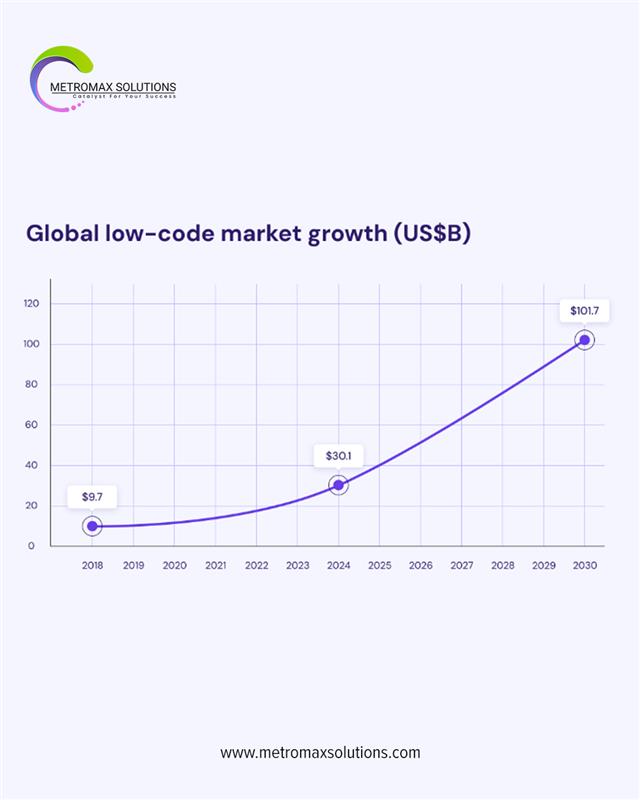
The Explosive Growth Of Low-Code: Markets To Hit $101.7 Billion By 2030
The market for low-code development is expanding at an unprecedented rate.
The Market’s Value – Estimated to grow at a 22.3% CAGR to reach $101.7 billion by 2030 (Statista).
Momentum of Revenue → Already at $30.1 billion in 2024, adoption has increased across industries.
Enterprise Need for Automation → Rapid market expansion is being driven by businesses implementing low-code platforms to reduce manual processes and streamline workflows.
Adoption of No-code by Enterprises and SMBs → Companies of all sizes, from Fortune 500s to startups, are adopting no-code development tools to speed up digital transformation without having to make significant IT investments.
Regional Dominance: North America dominates the global market due to the need for enterprise app scalability, automation, and CRM modernization.
Strategic Role → 31% of businesses already view low-code as an essential component of their software strategy rather than merely an add-on tool.
This growth indicates a clear takeaway for decision-makers: Businesses that avoid implementing low-code run the risk of losing their competitive edge, operational agility, and speed.
75% Of New Enterprise Apps Will Be Built on Low-Code by 2026
The widespread adoption of low-code is being fueled by the IT skills gap.
Developer Shortage: Even though 1.2 million software developers are expected to be needed by 2025, demand still exceeds supply.
Unfilled Positions: In 2020, 70% of businesses were unable to find IT personnel, which caused important projects to be delayed.
Enterprise Reliance: 75% of new apps will be developed using low-code or no-code by 2026, enabling business users to fill in where IT capacity is constrained.
Key Driver: Without having to wait months for IT teams, low-code platforms enable automation initiatives in supply chain, compliance, and CRM.
Low-code platforms provide the quickest means for businesses migrating their CRM or scaling Salesforce Marketing Cloud to implement custom workflows and customer engagement apps without prolonging project timelines.
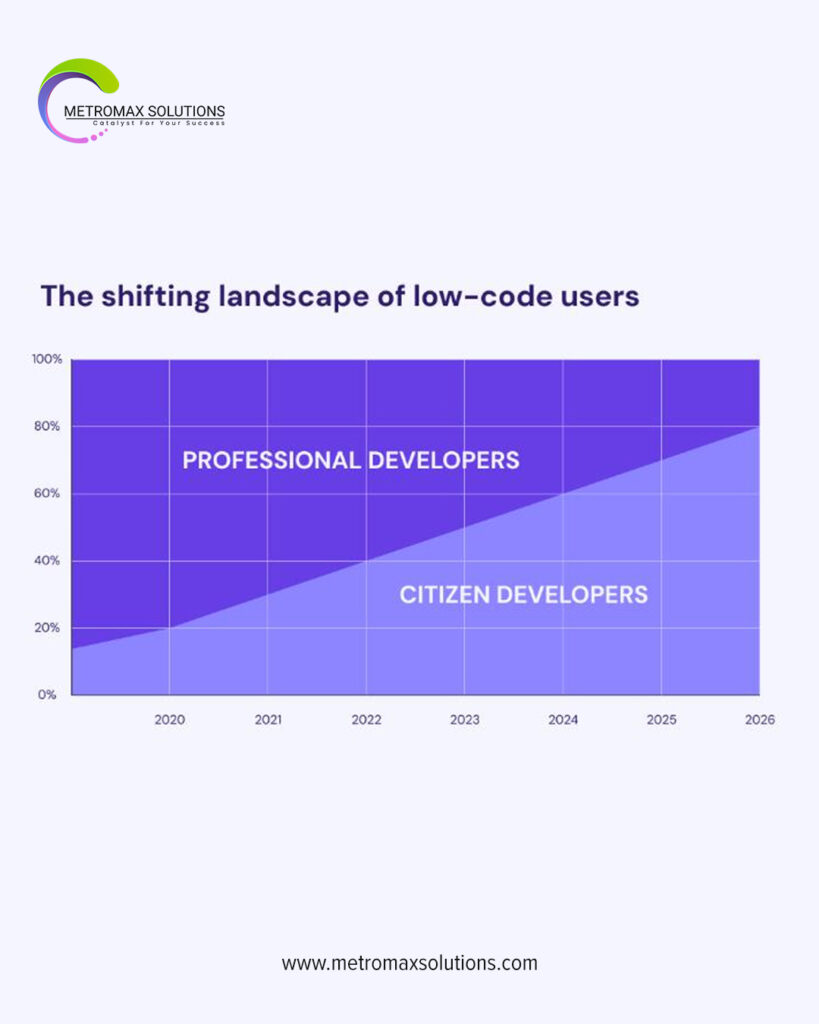
Citizen Developers Outpacing IT: 4-To-1 By 2025
One of the major changes in enterprise IT is the emergence of citizen developers.
Outnumbering IT: By 2025, there will be four times as many citizen developers as professional developers.
Enterprise Adoption: To empower business teams, 84% of enterprises currently support low-code/no-code tools.
Employee Shift: By 2026, marketing, operations, compliance, and customer service will account for 80% of low-code users who are not in IT.
Innovation Speed: According to 41% of organizations, citizen developers are driving new business solutions with shorter turnaround times and fewer backlogs.
Impact examples include:
Healthcare Providers: They can create telehealth and patient check-in apps in a matter of weeks rather than months.
Retailers Marketers: Without knowing how to code, they can create customized campaigns and loyalty apps within Salesforce Marketing Cloud.
Fintech Teams: They can automate risk dashboards, reporting, and KYC while IT concentrates on critical security requirements.
Businesses can reduce the risks associated with uncontrolled app development and maximize innovation by implementing the appropriate governance frameworks.
How Low-Code Delivers 90% Faster Development and 70% Cost Savings
Low-code platforms’ ROI is changing delivery cycles and IT budgets.
Speed Advantage: 72% of applications are delivered in less than three months, and application development can be completed up to 90% faster than traditional coding.
Cost Reduction: Organizations reduce development costs by 70%, breaking even in as little as 6–12 months.
Developer Relief: 90% of developers say they have fewer backlogs, which frees up IT teams to work on more complex projects.
Financial ROI: In three years, businesses typically see a 260% return on investment; some even report a 300% increase in the number of new products they launch.
Applications in Industry:
Logistics Companies: Reduce human error by automating fleet tracking and real-time shipment visibility.
Systems for Healthcare: Quicken digital services that interact with patients while adhering to HIPAA.
Fintech Providers: Quickly expand their offerings while adhering to changing legal requirements.
As a result, businesses see significant long-term savings, enhanced customer experiences, and a quicker time to market.
Challenges Enterprises Face With Low-Code Adoption In 2025
Despite its benefits, low-code adoption has drawbacks that businesses need to carefully consider.
Legacy System Integration: According to 42% of businesses, the largest obstacle to low-code adoption is antiquated infrastructure.
Governance Risks: In the absence of IT supervision, citizen developers might produce shadow apps that pose security and compliance issues.
Limitations on Customization: According to 39% of executives, low-code platforms are inadequate for intricate business processes.
Platform Complexity: 41% of companies say it’s more difficult to scale and maintain low-code platforms than they expected.
Security Issues with AI Integration: 62% of businesses are concerned about security flaws when integrating Generative AI (GenAI) with low-code platforms.
Strategies for finding solutions:
Create frameworks for the governance of citizen developers.
Use low-code hybrid platforms that enable custom coding for sophisticated applications.
Collaborate with low-code consulting professionals to match adoption to security and enterprise compliance requirements.
Future Trends: Industry-Specific Low-Code Solutions Transforming Healthcare, Retail, And Fintech
Industry-specific innovation is the next phase of low-code development platforms.
Healthcare: Telehealth solutions, patient engagement apps, and scheduling tools that comply with HIPAA.
Retail: Omnichannel applications for supply chain monitoring, loyalty, and mobile stores.
Fintech: Regulatory framework-aligned dashboards for automated KYC, fraud detection, and compliance.
Logistics: Real-time shipment tracking systems and fleet management enabled by IoT.
New developments for 2025–2026:
Low-code/no-code platforms will be used in the development of half of all new enterprise apps.
IT-business collaboration breaks down silos in 59% of low-code projects.
58% of IT executives have already used low-code to modernize legacy systems, allowing for quicker upgrades.
For businesses in regulated sectors, these industry-specific templates make low-code more accessible and effective by lowering adoption risk and speeding ROI.
MetroMax Solutions: Your Partner In Low-Code Success
MetroMax Solutions specializes in assisting businesses in leveraging the full potential of no-code development and low-code platforms. From CRM migration and Salesforce Marketing Cloud (SFMC) integration to developing scalable enterprise apps, our professionals provide quicker innovation at lower costs. While guaranteeing IT compliance, security, and scalability, we create governance frameworks that support citizen developers. With global delivery teams and project management based in the US, MetroMax Solutions is your go-to partner for low-code application development that propels digital transformation and speeds up growth.
Conclusion
The data makes it extremely clear that low-code dominance in 2025 is changing how businesses innovate. Three out of every four new applications will be developed on low-code or no-code platforms by 2026, which will result in quicker launches, cheaper expenses, and more accessible app development for all business divisions.
Low-code platforms offer the flexibility and cost-effectiveness required for businesses to remain competitive when scaling Salesforce Marketing Cloud, updating CRM systems, or going global.