Introduction
Personalisation sounds simple until you have to do it at scale.
It is common to know that someone visited your website. But to know what exactly did they look at, bought, or showed interest in matters the most. Such activities must be noted for several helping reasons.
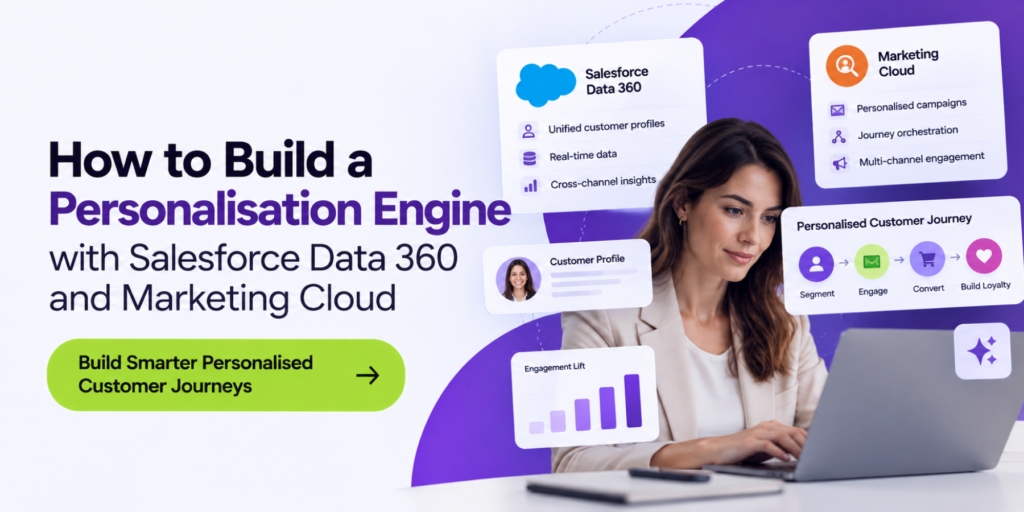
That’s when Salesforce Data 360 and Salesforce marketing cloud enters. Salesforce data 360 can contribute to bringing in the customer details and Salesforce marketing cloud use these customer details to curate a personalized experience.
What Is a Personalisation Engine?
A personalized engine takes the customer’s details to understand the scope. It uses these details to decide what kind of content, discount, recommendation, or experience must be shown to customer.
The idea is to use customer details and navigation behaviour to make the next experience more relevant.
1. Bring Your Customer Data Together
First and foremost, you must create a strong and efficient foundation for customer data.
Salesforce personalization bring together data of customers from various internal and external sources. It helps create unified customers profiles all along the various touch points.
This could include:
- CRM information
- Purchase history
- Website behaviour
- Email engagement
- Service interactions
- Loyalty activity
- Product preferences
Without this foundation, personalisation can become little more than guesswork.
2. Build Useful Customer Segments
Once your data is connected, the next step is customer segmentation salesforce users can actually use.
Data 360 allows marketers to create segments using attributes and behavioural information. These segments can then be published to activation targets.
For example, you could create segments for:
- First-time customers
- High-value customers
- Customers who haven’t purchased recently
- Product-specific interests
- Highly engaged subscribers Create few meaning customer segments instead of creating hundreds of the same.
Create few meaning customer segments instead of creating hundreds of the same.
3. Add Real-Time Behaviour
Good personalisation should not depend only on yesterday’s data.
Salesforce personalization often uses navigation behaviour, online activities, and customer profiles from Salesforce data 360 to encourage personalized experience for your customers. Whenever someone interacts with online channels, the profile will be automatically updated and will be used in altering the personalized solutions.
It simply means that campaigns and operations will be directly associated with customer’s choice.
4. Connect Personalisation With Marketing Cloud
Now comes the activation stage.
Salesforce personalization is connected with Salesforce data 360 to help provide customised experience in Salesforce cloud and marketing cloud will convert customer details into marketing journeys and interactions.
For example, if someone is viewing a particular product or service on the website repeatedly, an email, creative follow-up, or recommendations will be sent to the person instead of common traditional campaigns.
5. Use AI and Rules Where They Make Sense
Not every personalisation decision needs AI.
For straightforward campaigns, businesses can use rules such as:
If customer viewed Product A → show Product A content.
In case you want more innovative usage ideas, you can refer to Salesforce personalization. It supports goal oriented and machine learning recommenders which efficiently help in connecting customer interaction details with business context.
It is best to leverage simple strategies and smart recommendations.
6. Keep Improving the Experience
A personalisation engine is not the matter of one time project.
Track which recommendations, messages and offers perform well. Consider conversions, customer behaviour, interactions for better guidance in making adjustments regarding rules and segments.
With time, it will create a loop for feedbacks-
Data → Insight → Personalised Experience → Customer Response → Better Data
Conclusion
Building up the personalized engine should never be about sending personalized messages to every customer across your research sheet. It must be about using the already existing details to make customer segmentation and interaction more efficient.
If it is done in a proper manner, Salesforce personalisation can become less into adding the marketing messages and more about making every activity count.