Introduction
The criteria for searching is changing with time. People do not rely on traditional methods anymore. They prefer AI powered platforms for search results because it provides recommendations and comparison of products/services.
For modern methods, Generative Engine Optimisation (GEO) is worth investing in. But GEO shouldn’t be implemented into a business without proper strategic approach and website’s current standards.
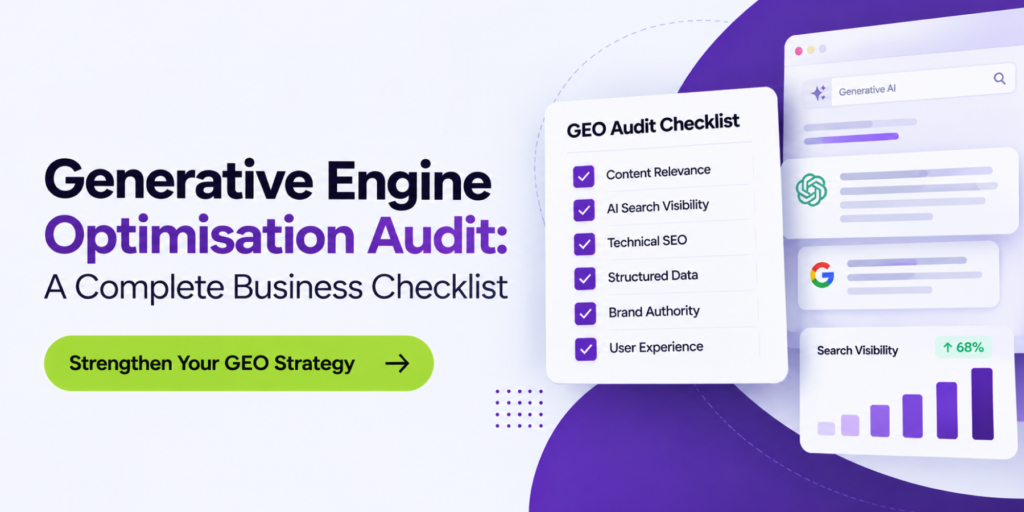
A GEO audit has the ability to identify if the business can be potentially cited, understood, and found by the customers.
What Is a GEO Audit?
Traditional SEO audits generally focus on limited criteria. But a GEO audit focus beyond rankings and keywords. It examines:
- How clearly your business is described
- Whether important content can be crawled
- How easily answers can be extracted from your pages
- Whether your expertise and claims are supported
- How consistently your brand appears across the web
- Whether AI platforms mention or cite your business
GEO Audit Checklist for Businesses
1. Check Your Website’s Crawl ability
Start off with the basics of tech. Make sure pages with important information are accessible and indexed for better chances of being visible in AI search results.
Check whether:
- Important pages are accessible to search crawlers
- Your robots.txt file is correctly configured
- Important pages are not accidentally marked
- Canonical tags are properly implemented
- Your website does not block important content behind unnecessary barriers
- Key content is accessible without complicated interactions
Audit question:
Can search systems easily access and understand my most important pages?
2. Review Your Business Entity Signals
Check your:
- Business name
- Company description
- Services
- Products
- Locations
- Contact information
- Founders or experts
- Industry/category
All the third party platforms like google business profile, social profiles, directories must have a consistent information about the business.
If the information is inconsistent, it will make your business entities hard to understand.
3. Audit Your Content for Direct Answers
One of the most important parts of a GEO audit checklist is to understand if the content your are putting up in your website is actually helpful for reader or not.
Ask:
- Does the page answer the main question quickly?
- Are headings clear?
- Are important facts easy to find?
- Does each section focus on one clear topic?
- Are complicated explanations supported with examples?
- Have unnecessary filler paragraphs been removed?
4. Check Your Expertise and Evidence
Review important claims throughout your website.
Look for:
- Original research
- Statistics with credible sources
- Expert opinions
- Case studies
- Customer examples
- Product specifications
- Author information
- Industry experience
- Relevant certifications
Do not make unrealistic claims like “number one” “leading” “the best” without proper testimonials and evidence.
5. Review Your Structured Data
Check whether appropriate schema is implemented for relevant content, such as:
- Organization
- Local Business
- Product
- Article
- Breadcrumb
- Review
6. Audit Your Off-Page Brand Presence
Your website is not entirely the single most important part of your business identity.
Search for your business across:
- Industry publications
- Review websites
- Business directories
- News websites
- Social platforms
- Forums
- Partner websites
- Professional profiles
7. Test Real AI Search Queries
Never end a GEO audit without actually testing the AI platforms.
Think carefully and curate a list of questions your potential customers might ask, such as:
- “Best [service] companies in [location]”
- “Who provides [service] for small businesses?”
- “Best alternatives to [competitor]”
- “How much does [service] cost?”
- “Which company should I choose for [problem]?”
Test these queries across relevant AI search experiences.
Record:
| Check |
Result |
|
Is your business mentioned?
|
Yes/No
|
|
Is a competitor mentioned?
|
Yes/No |
|
Is your website cited?
|
Yes/No |
|
Is your business information accurate?
|
Yes/No |
|
Is your brand recommended?
|
Yes/No |
This will provide a practical starting benchmark.
8. Identify Content Gaps
You may discover that competitors have pages answering questions such as:
- Pricing
- Comparisons
- Alternatives
- Product selection
- Common problems
- How-to guides
- Industry-specific solutions
Such gaps created an opportunity for GEO content optimisation.
9. Check Content Freshness
Outdated information can weaken search visibility.
Review:
- Old statistics
- Expired offers
- Outdated product information
- Old service descriptions
- Broken links
- Old company information
- Outdated industry regulations
Make sure to review your most important pages regularly.
10. Score and Prioritise Your GEO Audit
Don’t include everything aspect at once. It will only create more confusion and will lead to unfinished business.
Create three priority levels:
High Priority
- Crawlability problems
- Incorrect business information
- Missing important content
- Major trust or credibility gaps
Medium Priority
- Weak content structure
- Outdated pages
- Missing supporting content
- Inconsistent third-party information
Low Priority
- Minor formatting improvements
- Additional FAQs
- Supporting schema improvements
- Content expansion
Final GEO Audit Checklist
Before finishing your audit, ask:
- Is my website crawlable?
- Is my business clearly defined?
- Is my information consistent?
- Does my content answer real customer questions?
- Can important facts be easily understood?
- Do I demonstrate genuine expertise?
- Are my claims supported by evidence?
- Is my third-party presence accurate?
- Have I tested real AI search queries?
- Are competitors appearing where my business should?
- Is my content current?
- Do I have a process for monitoring AI visibility?
Conclusion
If you’re a business owner looking forward to integrating advanced search in your business, then GEO audit checklist will be at your service. It can turn hard to measure AI visibility into a sorted and practical marketing process.
The strongest approach combines:
- solid SEO fundamentals
- useful content
- clear business information
- credible evidence
- consistent brand signals
Google never recommend chasing the GEO shortcuts. Instead focusing on unique, people first, problem solving and valuable content outshine your business like nothing else.