Introduction
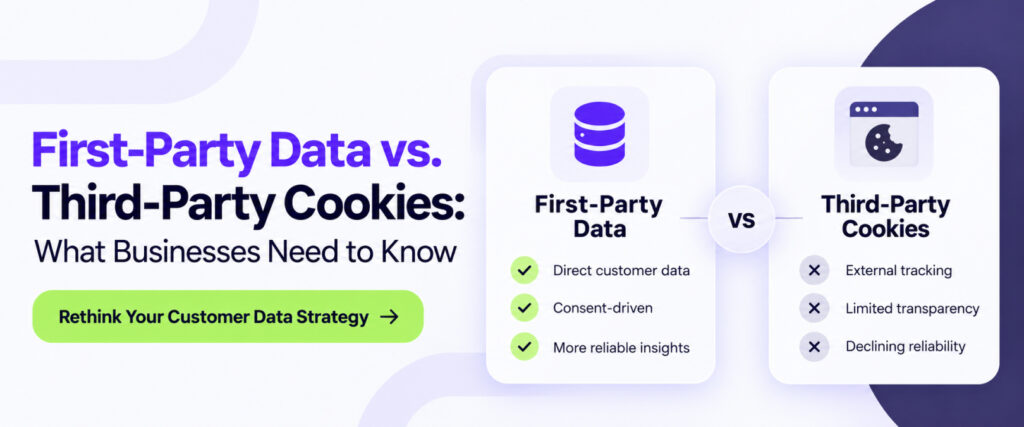
Most websites depend on third party cookies to understand customer navigation, buying patterns and target visitors. Since, digital marketing is evolving with each passing year, third party interference was restricted to zero. The users expect better privacy protocols around the internet. Hence, digital marketers can now no longer rely on third party cookies like before. This practice eventually brought focus to first party data marketing.
The first party data marketing is a setup that brings together the customer data directly from customers visiting the website. The best part about first party data is that it provides both good marketing and reliable privacy under one roof.
Meaning of First Party Data Marketing
The practice of collecting the data directly from the website visitors or customers, without the use of external data source, is called first-party data marketing. It is done with the objective of collecting data from customers and provide more relevant user experience through ad campaigns.
Following data is extracted from the visitors or customers through first-party data marketing.
- Identity details like name, contact, gender, email, location, etc.
- Buying habits like purchases, cart items, favourites, most visited products, refunds, etc.
- Browser navigation pattern like most visited websites, clicks, external links, ad clicks, session duration, IP address, etc.
- Interaction history like emails, newsletters, invites, in app messages, subscribed channels, likes, posts, etc.
- Rating patterns like customer support chats, survey responses, Feedbacks, product ratings, opinion forms, etc.
Benefits of First Party Data Marketing
Search engine privacy regulations are evolving for better customer experience. It helps cancel out the use of third party cookies from websites. Sharp browser tracking and privacy updates are striving for cookie less future. The pattern of collecting data from customers is also evolving.
No just privacy, but there are other benefits as well provided by first party data marketing. These benefits were absent when third-party data marketing was in use.
It includes-
- More relevant and customizable ads
- Understanding customer behaviour
- Customizable campaigns
- Better customer segmentation
- Tracking of performance
- Zero dependency on external sources
Having first party data marketing does not means that collecting more data is encouraged. The details which are actually useful and customer is comfortable sharing, should be extracted
5 Steps To Prepare For Cookie Less Future
1. Direct Data Collection
Look into the methods through which your customers interacts with your company.
It may be-
- Newsletters
- Channel subscriptions
- Feedback forms
- Customer support
- Social media platforms
- Website
- Ads
- Mobile Applications
Give customers a solid reason to share their details with your company. Extract the customer details through these channels and make use of the same for providing personalized experience.
2. Encourage Data Sharing
Any customer will only share their data and information if you provide a reason to them. Bring curiosity and benefits for customers in your content so the customer cannot leave without sharing their information.
For instance, instead of simply saying, “drop your email for future updates”, provide a valid reason.
Say “Drop your email to get notified about end of season sale”
In the terms & conditions, be very specific about how the details of customers will be used and also provide assurance about zero misuse.
Creating the transparency is the main rule of first-party data marketing.
3. Customer Segmentation
Never treat all the customers the same. Each individual has different location, preference, buying habits, etc. Divide all customers into groups and launch different campaigns for each group on basis of preference.
Curating a personalized experience for each customer will encourage relevancy. It will allow them to choose your company over the competitors.
4. Consider Ads
Reforming the website for cookie less approach does not mean you have remove ads from your strategy.
Instead of hunting for a new pool of audience, you can use the data of existing customers. Group them into segments and operate the ads with personalization across different platforms.
Hence, you will save the time invested in collecting data for unknown audience.
5. Utilize Suitable Technology
Managing first-party data marketing operations manually can be hectic and time consuming. Instead, invest in automation based CRMs like Salesforce. It will collect, arrange, and utilize the data in the best possible ways. It even has the ability to update the customer data time to time.
The technology must compliment your company’s workflow for smoother and efficient experience.
Therefore, with Salesforce integration, your goal to collect and manage customer data with privacy being the centre point is accomplished.
Conclusion
Earning the trust is the thumb rule of first-party data marketing.
The concept of cookie less future may be challenging, but it provides businesses with a new gateway to approach customers. The success lies in optimizing the workflow of customer data collection with credibility being the top priority.