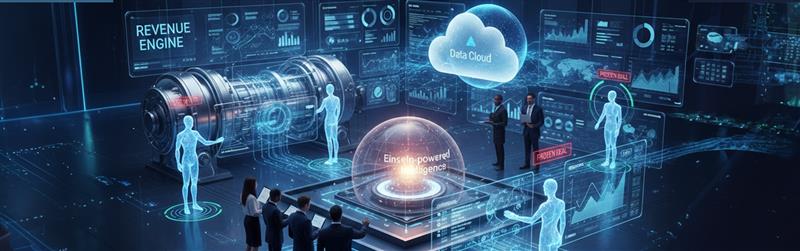
Salesforce driven e-commerce starts with the standardisation of customer data, which is then subsequently transformed into quantifiable KPIs, personalised programs, and operational actions that directly will augment growth of revenue and customer retention. The division of the content into specific sections makes it easier to comprehend and put these stages into practice by readers.
Why Data Matters in Modern Ecommerce
In the modern e-commerce, statistics can show what channels work best, what customer points have to be abandoned, and where spending is wasted. Salesforce Analytics and it goes with commerce cloud, data cloud and marketing cloud converts this raw data into actionable insights that generate increased growth that can be measured.
Building a Unified Customer View
Salesforce makes it possible to roll browsing behaviour, order history, email activity, loyalty activity, even offline communications into one customer profile. This is what is referred to as a holistic view because it not only explains the patterns of purchasing but also the identity of the customer, the points of entry, and ensuing events of every transaction.
Measuring Ecommerce Performance with KPIs
Using Salesforce Analytics, companies can track key performance indicators of e-commerce such as revenue, average order value, level of conversion, cart abandonment, the rate of repeat purchase, median lifetime value in real time. Dashboards compare the performance channels, campaigns, and new and returning visitors and enable the leaders to focus resources on the initiatives that can indeed improve the profitability and sales.
Powering Personalisation and Segmentation at Scale
With the help of Commerce Cloud and Data Cloud, the brands build dynamic segments on the basis of behaviour, preference, and the projected value. Thereafter, automation provides relevant product suggestions, abandoned-cart experiences, and loyalty services on a large scale thus increasing their engagement and conversion.
Using Analytics Beyond Marketing Dashboards
Salesforce analytics is not limited to marketing dashboard solutions but to sales, inventory, delivery, and service. Standardized reports allow leaders to realize low inventory, delays in shipping, or frequent problems with support at an earlier stage, predict demand better, and align the promotional activities with capacity.
Turning Insights into Continuous Optimisation
In an e-commerce model that is based on data, analytics, AI, and automation are interdependent in the sense that every insight triggers immediate testing and optimization. Real-time behaviour reaction, i.e. changing assortments, pricing, content and campaigns, enables Salesforce-powered brands to rise faster, increase loyalty, and remain competitive.
From Fragmented Data to Competitive Advantage
Salesforce Analytics is a direct step to converting the fragmented data into the targeted action, and it has already become a key condition of the sustainable growth of e-commerce. With the union of customer data, the tracking of the correct KPIs, scale-based personalization, and insights integrated into decisions daily, in marketing, operation, and service, teams shift their speculation to evidence-based strategy and create a sustainable competitive advantage within crowded markets.